Afghan officials: Pakistan frees Taliban detainees

0 comments

KABUL, Afghanistan (AP) — Pakistan has freed eight Taliban prisoners and has agreed to release many more to help kick start a peace process that could lead to a political resolution of the 11-year-old Afghan war, Afghan officials said Thursday.

The decision to release the prisoners, including the former justice minister from when the repressive Taliban ruled Afghanistan, is seen as a signal that neighboring Pakistan might be willing to take concrete steps to revive efforts to lure the group to the negotiating table.

The three Afghan officials, who spoke on condition of anonymity as they are not yet authorized to discuss the results of the sensitive meetings in Islamabad, are familiar with the four-day trip that the Afghan government's peace council made there this week.

The U.S. and its allies fighting in Afghanistan are pushing to strike a peace deal with the Taliban so they can withdraw most of their troops by the end of 2014. But considerable obstacles remain, and it is unclear whether the Taliban even intend to take part in the process, rather than just wait until foreign forces withdraw.

Pakistan is seen as key to the peace process. Islamabad has ties to the Taliban that date back to the 1990s, and many of the group's leaders are believed to be based on Pakistani territory, having fled there following the U.S.-led invasion of Afghanistan in 2001.

The officials said the first group of prisoners was released on Wednesday as a goodwill gesture, and that Pakistani officials had agreed to free anywhere from 15 to 32 more prisoners in the future to help build traction for formal talks with the Taliban.

Two of the officials said former Taliban Justice Minister Nooruddin Turabi was among those released on Wednesday. Turabi, a native of Kandahar who is in his late 40s or early 50s, is missing an eye and has only one leg. He is believed to have played a role in the destruction of two, 1,500-year-old sandstone Buddha statues that once towered some 180 feet high in central Afghanistan. The Taliban, who considered them symbols of paganism, destroyed them in 2001.

A joint statement issued by Pakistan and Afghanistan on Wednesday said "a number of Taliban detainees are being released" to support the peace process at the request of the Afghan government. It also called on the Taliban and other armed opposition groups to participate in peace talks and sever links with al-Qaida. Neither the Pakistani nor Afghan governments have officially confirmed the identities of the prisoners released.

However, one of the officials familiar with the peace process gave The Associated Press a list of the Taliban prisoners — some identified by only one name — that Pakistan agreed to release. The eight prisoners on the list were:

—Turabi.

—Jahangirwal, who was a special assistant for the Taliban's top leader, Mullah Omar.

—Qutub, a Taliban leader.

—Abdul Salaam, the Taliban's former governor of Baghlan province.

—Maulvi Matiullah, who was director of the customs house in Kabul under the Taliban regime;

—Mahamad, the Taliban's former governor of Kunduz province.

—Sayed Saduddin Agha, a former Taliban commander.

—Allah Dad, the Taliban's former deputy minister of communication.

The eight are among 40 Taliban prisoners that the Afghan government has asked Pakistan to release.

Also on the list of 40 is the Taliban's former deputy leader, Mullah Abdul Ghani Baradar, who was captured in Pakistan in 2010.

Baradar is seen by some as crucial to the peace process. Baradar was reportedly conducting talks with the Afghan government that were kept secret from the Pakistanis, and his arrest in the sprawling southern port city of Karachi reportedly angered Afghan President Hamid Karzai.

Pakistan helped the Taliban seize control of Afghanistan in the 1990s — providing funding, weapons and intelligence — and the Afghan government and the U.S. have accused Islamabad of continuing to support the group. Pakistan has denied the allegations, but many analysts believe the country continues to see the militant group as an important ally in Afghanistan to counter archenemy India.

However, Pakistan is also worried about instability in Afghanistan following the planned withdrawal of foreign forces. If civil war breaks out again as it did in the 1990s, hundreds of thousands of Afghan refugees could stream across the border into Pakistan. Violence could also give greater cover to Pakistani militants who are at war with Islamabad.

These concerns have made a peace deal more urgent in the minds of Pakistanis.

___

Associated Press writers Kathy Gannon in Islamabad, Pakistan, and Deb Riechmann in Kabul contributed to this report.

Read More..

GameStop profit beats forecast; cautiously eyes holiday

0 comments


SAN FRANCISCO (Reuters) – GameStop Corp, the world’s largest retailer of videogame products, reported a stronger-than-expected profit on Thursday but lowered its sales forecast for this year due to uncertainty around the holiday shopping season as the video game market struggles.


Grapevine, Texas-based GameStop forecast same-store sales in 2012 would drop 6 percent to 9 percent, compared with a 2 to 10 percent decline projected previously.


“We’ve continued to find new ways to drive revenues and margins in our stores and that’s enabled us to hold on to some earnings in these difficult times,” Chief Financial Officer Rob Lloyd said in an interview.


“We’re still a little bit cautious in that it’s a difficult environment in which to forecast because the industry has been down,” Lloyd said. “And we’ve got uncertainty surrounding what the supply of the (Nintendo)Wii U is going to be.”


Nintendo Co Ltd is gearing up to launch its Wii U video game console on November 18. It is the first new home console device to be sold by a major gaming company in more than six years.


GameStop hopes the start of a new console cycle with the Wii U launch and just-released high quality games like Microsoft Corp’s “Halo 4″ and Activision Blizzard’s “Call of Duty: Black Ops II” will boost hardware and software sales this holiday season.


GameStop’s shares rose 4.25 percent to $ 24.48 in afternoon trading on the New York Stock Exchange.


Sterne Agee analyst Arvind Bhatia said investors seem more comfortable now with the company’s recent efforts to drive profitability.


In the last two years, the company has been tackling decelerating video game sales in a tough market by diversifying its revenue sources, selling electronics like tablets, digital video games and used games.


The games retailer said it had repurchased stock worth $ 76.8 million in the third quarter and announced that its board had approved a new $ 500 million share buy-back plan to replace its existing $ 242 million repurchase plan. It also announced a quarterly dividend of 25 cents, same as last quarter.


The company reported adjusted net earnings per share of 38 cents in the third quarter, beating analysts’ expectations of 32 cents.


“Earnings per share was quite impressive, driven by gross margins being strong and cost control,” Sterne Agee’s Bhatia said.


GameStop said it expects comparable store sales to range between down 7 percent and up 1 percent in the fourth quarter. It forecast earnings per share between $ 2.07 to $ 2.27 for the period.


Sales of traditional videogame products such as consoles have been pressured globally by lower-priced online offerings and gamers spending more time on tablet computers and cell phones.


Total U.S. sales of videogame software in October dropped 25 percent from a year ago, following a similar trend throughout the third quarter, according to a report by market research firm NPD.


GameStop said sales fell 8.9 percent to $ 1.77 billion. Analysts were expecting sales of $ 1.79 billion, according to Thomson Reuters I/B/E/S.


Adjusted earnings were $ 47.2 million, compared with $ 53.9 million a year ago. The company maintained its previously announced full-year earnings outlook of between $ 3.10 per share to $ 3.30 per share.


(Reporting by Malathi Nayak; editing by John Wallace, Maureen Bavdek, David Gregorio and Dan Grebler)


Internet News Headlines – Yahoo! News


Read More..

DA: Heroin charge dropped vs. Bon Jovi's daughter

0 comments

CLINTON, N.Y. (AP) — Drug charges against Jon Bon Jovi's 19-year-old daughter have been dropped, a central New York prosecutor said Thursday.

Stephanie Bongiovi was found unresponsive by medics after she apparently overdosed on heroin in a Hamilton College dorm early Wednesday. Town of Kirkland police charged Bongiovi, of Red Bank, N.J., and fellow student Ian Grant, also of Red Bank, with possession of a small amount of heroin and marijuana.

Oneida County District Attorney Scott McNamara said he was dismissing the charges against both students. Under state law, someone having a drug overdose or seeking help for an overdose victim can't be prosecuted for having a small amount of heroin or any amount of marijuana.

The so-called Good Samaritan 911 law signed by Gov. Andrew Cuomo in July 2011 was designed to reduce overdose deaths by encouraging people to call 911 without fear of being arrested for drug possession. Similar laws have been passed in several other states.

Bon Jovi, 50, is scheduled to perform at a concert to benefit Hamilton's scholarships and arts programs in Times Square on Dec. 5. He has not commented on his daughter's overdose.

He has four children, Stephanie and three sons.

Read More..

Diabetes rates rocket in Oklahoma, South

0 comments

NEW YORK (AP) — The nation's diabetes problem is getting worse, and the biggest jump over 15 years was in Oklahoma, according to a new federal report issued Thursday.

The diabetes rate in Oklahoma more than tripled, and Kentucky, Georgia and Alabama also saw dramatic increases since 1995, the study showed.

The South's growing weight problem is the main explanation, said Linda Geiss, lead author of the report by the Centers for Disease Control and Prevention study.

"The rise in diabetes has really gone hand in hand with the rise in obesity," she said.

Bolstering the numbers is the fact that more people with diabetes are living longer because better treatments are available.

The disease exploded in the United States in the last 50 years, with the vast majority from obesity-related Type 2 diabetes. In 1958, fewer than 1 in 100 Americans had been diagnosed with diabetes. In 2010, it was about 1 in 14.

Most of the increase has happened since 1990.

Diabetes is a disease in which the body has trouble processing sugar; it's the nation's seventh leading cause of death. Complications include poor circulation, heart and kidney problems and nerve damage.

The new study is the CDC's first in more than a decade to look at how the nationwide boom has played out in different states.

It's based on telephone surveys of at least 1,000 adults in each state in 1995 and 2010. Participants were asked if a doctor had ever told them they have diabetes.

Not surprisingly, Mississippi — the state with the largest proportion of residents who are obese — has the highest diabetes rate. Nearly 12 percent of Mississippians say they have diabetes, compared to the national average of 7 percent.

But the most dramatic increases in diabetes occurred largely elsewhere in the South and in the Southwest, where rates tripled or more than doubled. Oklahoma's rate rose to about 10 percent, Kentucky went to more than 9 percent, Georgia to 10 percent and Alabama surpassed 11 percent.

An official with Oklahoma State Department of Health said the solution is healthier eating, more exercise and no smoking.

"And that's it in a nutshell," said Rita Reeves, diabetes prevention coordinator.

Several Northern states saw rates more than double, too, including Washington, Idaho, Montana, Wyoming, South Dakota, Minnesota, Missouri, Ohio and Maine.

The study was published in CDC's Morbidity and Mortality Weekly Report.

___

Associated Press writer Ken Miller in Oklahoma City contributed to this report.

___

Online:

CDC report: http://tinyurl.com/cdcdiabetesreport

Read More..

BP employees charged with manslaughter

0 comments

NEW ORLEANS (AP) — Two men who worked for BP during the 2010 Gulf oil spill disaster have been charged with manslaughter and a third with lying to federal investigators, according to indictments made public Thursday, hours after BP announced it was paying $4.5 billion in a settlement with the U.S. government over the disaster.

A federal indictment unsealed in New Orleans claims BP well site leaders Robert Kaluza and Donald Vidrine acted negligently in their supervision of key safety tests performed on the Deepwater Horizon drilling rig before the explosion killed 11 workers in April 2010. The indictment says Kaluza and Vidrine failed to phone engineers onshore to alert them of problems in the drilling operation.

Another indictment charges David Rainey, who was BP's vice president of exploration for the Gulf of Mexico, on charges of obstruction of Congress and false statements. The indictment claims the former executive lied to federal investigators when they asked him how he calculated a flow rate estimate for BP's blown-out well in the days after the April 2010 disaster.

Before Thursday, the only person charged in the disaster was a former BP engineer who was arrested in April on obstruction of justice charges. He was accused of deleting text messages about the company's response to the spill.

Earlier in the day, BP PLC said it would plead guilty to criminal charges related to the deaths of 11 workers and lying to Congress.

The day of reckoning comes more than two years after the nation's worst offshore oil spill. The figure includes nearly $1.3 billion in criminal fines — the biggest criminal penalty in U.S. history — along with payments to certain government entities.

"We believe this resolution is in the best interest of BP and its shareholders," said Carl-Henric Svanberg, BP chairman. "It removes two significant legal risks and allows us to vigorously defend the company against the remaining civil claims."

The settlement, which is subject to approval by a federal judge, includes payments of nearly $2.4 billion to the National Fish and Wildlife Foundation, $350 million to the National Academy of Sciences and about $500 million to the Securities and Exchange Commission. The SEC accused BP of misleading investors by lowballing the amount of crude spewing from the ruptured well.

London-based BP said in a statement that the settlement would not cover any civil penalties the U.S. government might seek under the Clean Water Act and other laws. Nor does it cover billions of dollars in claims brought by states, businesses and individuals, including fishermen, restaurants and property owners.

A federal judge in New Orleans is weighing a separate, proposed $7.8 billion settlement between BP and more than 100,000 businesses and individuals who say they were harmed by the spill.

BP will plead guilty to 11 felony counts of misconduct or neglect of a ship's officers, one felony count of obstruction of Congress and one misdemeanor count each under the Migratory Bird Treaty Act and the Clean Water Act. The workers' deaths were prosecuted under a provision of the Seaman's Manslaughter Act. The obstruction charge is for lying to Congress about how much oil was spilling.

The penalty will be paid over five years. BP made a profit of $5.5 billion in the most recent quarter. The largest previous corporate criminal penalty assessed by the U.S. Justice Department was a $1.2 billion fine imposed on drug maker Pfizer in 2009.

Read More..

Report: Sri Lankan war was grave failure for UN

0 comments

UNITED NATIONS (AP) — A United Nations report released Wednesday said inadequate efforts by the world body to protect civilians during the bloody final months of Sri Lanka's civil war marked a "grave failure" that led to suffering for hundreds of thousands of people.

The report was unusually scathing for an official U.N. critique.

The report accused U.N. staff in Colombo of not perceiving that preventing civilian deaths was their responsibility and accused their bosses at U.N. headquarters of not telling them otherwise. A separate U.N. report released last year said up to 40,000 ethnic minority Tamil civilians may have been killed in the war's final months.

"This report is a benchmark moment for the U.N. in the same way that Rwanda was," said Gordon Weiss, a former U.N. spokesman in Sri Lanka.

The report accused U.N. officials and member states of being reluctant to interfere and leaving the conflict in a "vacuum of inaction."

"The report concludes that the United Nations system failed to meet its responsibilities — highlighting, in particular, the roles played by the Secretariat, the agencies and programs of the U.N. Country Team and the members of the Security Council and Human Rights Council," Secretary-General Ban Ki-moon said in a statement.

The report was compiled by a committee headed by former U.N. official Charles Petrie. It investigated U.N. actions as the quarter-century war between the government, dominated by the ethnic Sinhalese majority, and minority Tamil rebels ended in 2009 in a wave of violence.

The BBC first reported on a draft of the report Tuesday.

The draft, obtained by The Associated Press shortly before the final report was released, began with an "executive summary" that detailed the U.N. failure on the ground, saying that the political conditions after the Sept. 11, 2001, terror attacks in the U.S. made countries less likely to stop a government fighting against a group — the Tamil Tiger rebels — that many had branded a terrorist organization.

The executive summary was deleted from the official published version issued on Wednesday.

The draft report painted a picture of a U.N. operation reluctant to criticize the government or accuse it of killing civilians with artillery bombardments, out of concern the government would respond by limiting U.N. humanitarian access — even through U.N. aid workers were barred from the northern war zone in late 2008.

Top U.N. officials in the country repeatedly worked to soften statements to remove casualty figures and accusations of possible war crimes against the government, the official report said. When death tolls its staff was compiling were released, top officials dismissed them as unverified despite the rigorous methodology being used, the report said.

When U.N. satellite images confirmed heavy artillery shelling in the war zone and showed far more civilians there than the government claimed, the top U.N. official in Sri Lanka downplayed the evidence in a letter to the government, the final version of the report said. At the same time, member states did not hold a single formal meeting on the conflict in its final months in the Security Council, Human Rights Council or the General Assembly.

"The UN set itself up for failure, in Sri Lanka," the draft report said, in another quote deleted from the final, official report.

The report also accused the government of working to intimidate U.N. staff, of withholding visas of those critical of the government and of planting false allegations against them in the media.

The U.N. representative for Human Rights Watch, Philippe Bolopion, said "The U.N.'s dereliction of duty in Sri Lanka is a stark reminder of what happens when human rights concerns are marginalized or labeled as too political."

___

Nessman reported from New Delhi.

Read More..

NASCAR’s Keselowski can’t tweet in car anymore

0 comments


CHARLOTTE, N.C. (AP) — Brad Keselowski became a social media darling after hopping on Twitter during a lengthy delay in the Daytona 500.


Keselowski was the center of attention, and NASCAR seemed trendy and hip — a description its executives surely adored.


Turns out, tweeting from the car isn’t cool with NASCAR.


Keselowski was fined $ 25,000 on Monday for tweeting during the red flag at Phoenix International Raceway. The punishment was confusing to fans who vented on Twitter, of course, wondering why Keselowski was punished for Sunday’s tweets when he was celebrated by NASCAR for doing the exact same thing in February’s season-opening race.


Some alleged the Sprint Cup Series points leader was actually being disciplined for his profanity-laced outburst after Sunday’s crash- and fight-marred race.


NASCAR spokesman Kerry Tharp on Tuesday dismissed the conspiracy theories, and said drivers had been told after the Daytona 500 that electronic devices — including cellphones — could not be carried inside the race cars going forward.


“Brad’s tweeting at the Daytona 500 was really our first introduction to the magnitude of the social media phenomenon at the race track, especially how we saw it unfold that evening,” Tharp said. “We encourage our drivers to participate in social media. We feel we have the most liberal social media policy in all of sports, and the access we provide is the best in all of sports.


“But we also have rules that pertain to competition that need to be enforced and abided by. Once the 500 took place, and in the days and weeks following the 500, NASCAR communicated to the drivers and teams that while social media was encouraged and we promoted it, the language in the rule book was clear and that drivers couldn’t carry onboard their cars electronic devices, like a phone.”


Keselowski, who takes a 20-point lead over Jimmie Johnson into Sunday’s season finale in his quest to win his first Sprint Cup Series title, has not commented on his penalty.


But with the championship on the line, his crew chief indicated Tuesday he’ll be doing his best to keep the phone out of the No. 2 Dodge this weekend.


“Never even crossed my mind, to be honest with you,” Paul Wolfe said. “We get so involved in worrying about how to make the race car go around the track that, obviously, Brad’s cellphone is not on my mind a whole lot. I’ll definitely remind him this weekend.”


The Daytona 500 was stopped for nearly two hours when Juan Pablo Montoya crashed into a jet dryer that was cleaning the track during a caution period. The crash caused a fuel explosion, and Keselowski used his phone to tweet pictures, answer questions and give updates on the cleanup during the delay.


The race, which had been rained out for the first time in 54 runnings, was being aired on Monday night in prime time for the first time in history and Keselowski’s tweeting drew worldwide headlines.


Afterward, NASCAR specifically said Keselowski did not violate a rule barring onboard electronic devices and would not be penalized.


“Nothing we’ve seen from Brad violates any current rules pertaining to the use of social media during races,” NASCAR said the day after the race. “We encourage our drivers to use social media to express themselves as long as they do so without risking their safety or that of others.”


NASCAR did not issue a technical bulletin to clarify phones could no longer be inside cars, and the clarification to drivers was apparently done quietly. In fact, Keselowski tweeted from Victory Lane at Bristol in March, and from inside his car parked on pit road during a rain delay at Richmond in September. It’s possible someone could have handed him his phone both times.


A year ago, the outspoken Penske Racing driver was fined $ 25,000 headed into the finale for criticizing electronic fuel injection. At the time, NASCAR had been privately punishing drivers for making disparaging remarks about the series, but word of Keselowski’s fine leaked and forced NASCAR to change its policy during the offseason.


Still, many fans were convinced this week’s fine against Keselowski was actually for his post-race comments about the aggressive racing at Phoenix.


He’d been criticized by several drivers for racing Johnson hard over a pair of late restarts at Texas a week earlier, and felt his aggressive driving paled in comparison to Jeff Gordon intentionally wrecking Clint Bowyer with two laps to go on Sunday. Gordon’s retaliation also collected Joey Logano and Aric Almirola, and forced Keselowski to weave his way around the accident.


“It just drives me absolutely crazy that I get lambasted for racing somebody hard without there even being a wreck and then you see stuff like this … from the same people that criticized me,” he said. “It’s OK to just take somebody out. But you race somebody hard, put a fender on somebody and try to go for the win, and you’re an absolute villain. We can just go out and retaliate against each other and come back in and smile about it, and it’s fine. That’s not what this sport needs. It needs hard racing, it needs people that go for broke, try to win races and put it all out there on the line. Not a bunch of people that have anger issues.”


Social Media News Headlines – Yahoo! News


Read More..

Judge tosses anti-paparazzi counts in Bieber case

0 comments

LOS ANGELES (AP) — A law aimed at combating reckless driving by paparazzi is overly broad and should not be used against the first photographer charged under its provisions, a judge ruled Wednesday.

Superior Court Judge Thomas Rubinson dismissed counts filed under the law against Paul Raef, who was charged in July with being involved in a high-speed pursuit of Justin Bieber.

The judge cited numerous problems with the 2010 law, saying it was aimed at First Amendment newsgathering activities, and lawmakers should have simply increased the penalties for reckless driving rather than targeting celebrity photographers.

Attorneys for Raef argued the law was unconstitutional and was meant merely to protect celebrities while punishing people who gather news.

"This discrimination sets a dangerous precedent," attorney Brad Kaiserman said.

Prosecutors argued that the law, which seeks to punish those who drive dangerously in pursuit of photos for commercial gain, didn't merely apply to the media but could apply to people in other professions.

Rubinson cited hypothetical examples in which wedding photographers or even photographers rushing to a portrait shoot with a celebrity could face additional penalties if charged under the new statute.

Raef still faces traditional reckless driving counts.

Prosecutors allege he chased Bieber at more than 80 mph and forced other motorists to avoid collisions while Raef tried to get shots of the teen heartthrob on a Los Angeles freeway in July.

Raef has not yet entered a plea in the case.

___

Anthony McCartney can be reached at http://twitter.com/mccartneyAP

Read More..

New gene triples risk for Alzheimer's disease

0 comments

Scientists have identified a new gene variant that seems to strongly raise the risk for Alzheimer's disease, giving a fresh target for research into treatments for the mind-robbing disorder.

The problem gene is not common — less than 1 percent of people are thought to have it — but it roughly triples the chances of developing Alzheimer's compared to people with the normal version of the gene. It also seems to harm memory and thinking in older people without dementia.

The main reason scientists are excited by the discovery is what this gene does, and how that might reveal what causes Alzheimer's and ways to prevent it. The gene helps the immune system control inflammation in the brain and clear junk such as the sticky deposits that are the hallmark of the disease. Mutations in the gene may impair these tasks, so treatments to restore the gene's function and quell inflammation may help.

"It points us to potential therapeutics in a more precise way than we've seen in the past," said Dr. William Thies, chief medical and scientific officer of the Alzheimer's Association, which had no role in the research. Years down the road, this discovery will likely be seen as very important, he predicted.

It is described in a study by an international group published online Wednesday by the New England Journal of Medicine.

About 35 million people worldwide have dementia, and Alzheimer's is the most common type. In the U.S., about 5 million have Alzheimer's. Medicines such as Aricept and Namenda just temporarily ease symptoms. There is no known cure.

Until now, only one gene — ApoE — has been found to have a big impact on Alzheimer's risk. About 17 percent of the population has at least one copy of the problem version of this gene but nearly half of all people with Alzheimer's do. Other genes that have been tied to the disease raise risk only a little, or cause the less common type of Alzheimer's that develops earlier in life, before age 60.

The new gene, TREM2, already has been tied to a couple other forms of dementia. Researchers led by deCODE Genetics Inc. of Iceland honed in on a version of it they identified through mapping the entire genetic code of more than 2,200 Icelanders.

Further tests on 3,550 Alzheimer's patients and more than 110,000 people without dementia in several countries, including the United States, found that the gene variant was more common in Alzheimer's patients.

"It's a very strong effect," raising the risk of Alzheimer's by three to four times — about the same amount as the problem version of the ApoE gene does, said Dr. Allan Levey, director of an Alzheimer's program at Emory University, one of the academic centers participating in the research.

Researchers also tested more than 1,200 people over age 85 who did not have Alzheimer's disease and found that those with the variant TREM2 gene had lower mental function scores than those without it. This adds evidence the gene variant is important in cognition, even short of causing Alzheimer's.

"It's another piece in the puzzle. It suggests the immune system is important in Alzheimer's disease," said Andrew Singleton, a geneticist with the National Institute on Aging, which helped pay for the study.

One prominent scientist not involved in the study — Dr. Rudolph Tanzi, a Harvard Medical School geneticist and director of an Alzheimer's research program at Massachusetts General Hospital — called the work exciting, but added a caveat.

"I would like to see more evidence that this is Alzheimer's" rather than one of the other dementias already tied to the gene, Tanzi said. Autopsy or brain imaging tests can show whether the cases attributed to the gene variant are truly Alzheimer's or misdiagnosed, he said.

___

Online:

Medical journal: http://www.nejm.org

Alzheimer's info: http://www.alzheimers.gov

Alzheimer's Association: http://www.alz.org

___

Marilynn Marchione can be followed at http://twitter.com/MMarchioneAP

Read More..

Obama warns GOP to lay off Rice attacks

0 comments

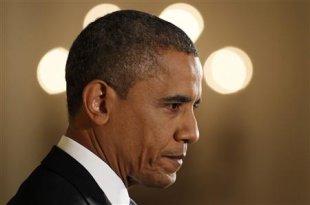
President Barack Obama speaks at his first news conference since his re-election. (Kevin Lamarque/Reuters)President Barack Obama bluntly told Sen. John McCain and other Republicans to lay off their attacks against U.N. Ambassador Susan Rice over the Benghazi assault, telling lawmakers that if they go after her "then you have a problem with me." And Obama, speaking at his first postelection press conference, vowed that Republican opposition would not dissuade him from nominating Rice to replace departing Secretary of State Hillary Clinton.


"I don't think there's any debate in this country that when you have four Americans killed that's a problem," he told reporters in the East Room of the White House. "And we've got to get to the bottom of it, and there needs to be accountability. We've got to bring those who carried it out to justice—they won't get any debate from me on that.


"But when they go after the U.N. ambassador, apparently because they think she's an easy target, then they've got a problem with me," he warned.


McCain, Sen. Lindsey Graham of South Carolina and other Republicans have signaled they will oppose Rice's confirmation if Obama nominates her. Their numbers thus far seem far short of the 40 needed to block it, and some Republican senators have signaled that she should get a fair hearing.


"Let me say specifically about Susan Rice: She has done exemplary work. She has represented the United States and our interests in the United Nations with skill and professionalism and toughness and grace," Obama said.


"And should I choose, if I think that she would be the best person to serve America in the capacity of the State Department, then I will nominate her," he vowed. "That's not a determination that I've made yet."


Rice and Democratic Sen. John Kerry, who chairs the Senate Foreign Relations Committee, are seen as the front-runners in the race to succeed Clinton.


Conservatives have assailed Rice, who is close to Obama, ever since she made the rounds of the Sunday morning talk shows and said that American intelligence believed the attack on the American compound in Benghazi, which claimed the lives of U.S. Ambassador Chris Stevens and three other Americans, grew out of demonstrations against an Internet video that ridicules Islam.


"As that unfolded, it seems to have been hijacked, let us say, by some individual clusters of extremists who came with heavier weapons, weapons that, as you know, in the wake of the revolution in Libya are quite common and accessible. And it then evolved from there," she told ABC.


White House aides have said Rice was speaking based on the best available intelligence at the time.


"She made an appearance at the request of the White House in which she gave her best understanding of the intelligence provided to her," Obama said Wednesday. "If Sen. McCain and Sen. Graham want to go after somebody, they should go after me.


"But for them to go after the U.N. ambassador, who had nothing to do with Benghazi and was simply making a presentation based on intelligence that she had received, and to besmirch her reputation is outrageous," he said.


"We're after an election now," he scolded. "I think it is important for us to find out exactly what happened in Benghazi, and I'm happy to cooperate in any ways that Congress wants. We have provided every bit of information that we have and we will continue to provide information, and we've got a full-blown investigation. And all that information will be disgorged to Congress."


McCain and Graham hit back quickly.


"I have always said that the buck stops with the President of the United States," the Arizona senator said in a written statement. McCain accused Obama of "contradictory statements" about the attack, labeling it an "act of terror" the day after it happened and then resisting the use of the word "terrorism" for roughly a week afterward.


"We owe the American people and the families of the murdered Americans a full and complete explanation, which for two months the President has failed to deliver," said McCain, who has called for Congress to create a "select committee" to investigate.


"Mr. President, don't think for one minute I don't hold you ultimately responsible for Benghazi. I think you failed as commander in chief before, during and after the attack," Graham said in a statement released by his office.


"We owe it to the American people and the victims of this attack to have full, fair hearings and accountability be assigned where appropriate. Given what I know now, I have no intention of promoting anyone who is up to their eyeballs in the Benghazi debacle," Graham said.


Obama opened what was his first press conference in months with a vow to work with both parties in Congress to tackle the so-called fiscal cliff and revive the economy. He also said he had "no evidence" that the scandal that led David Petraeus to resign in disgrace from his job as CIA director had led to breaches in classified national security material.


"Right now our economy is still recovering from a very deep and damaging crisis, so our top priority has to be jobs and growth," Obama said in opening remarks in the East Room of the White House.


"Both parties can work together" to address the fiscal challenges "in a balanced and responsible way," he said, before pushing Republicans to sign on to his call for raising taxes on the richest Americans.


Asked whether the scandal that drove Petraeus from office had led to national security breaches, Obama replied: "I have no evidence at this point, from what I've seen, that classified information was disclosed that in any way would have had a negative impact on our national security." And the president praised the retired general, saying, "We are safer because of the work Dave Petraeus has done."


Asked for his appraisal of the FBI's work in bringing to light the marital infidelity that Petraeus cited in his resignation message, and why he and the American public learned of the probe only earlier this month, Obama said, "I am withholding judgment" on that process but expressed "a lot of confidence generally in the FBI."


Turning to his tax battle with Republicans, Obama stuck by his vow to oppose any legislation that extends the Bush-era tax cuts for the wealthiest 2 percent of Americans. The president, asked why he had agreed to extend them in the 2010 lame-duck session of Congress, said that "was a one-time proposition" and that "we cannot afford" to do so again.


Obama said he would be willing to look at raising tax revenue by closing loopholes. But he warned that doing so would probably not outweigh an estimated trillion dollars lost by extending tax cuts on income above $250,000. "The math tends not to work," he said.


"I just want to emphasize: I am open to new ideas," Obama underlined. "If the Republican counterparts or some Democrats have a great idea for us to raise revenue, maintain progressivity, make sure the middle class isn't getting hit, reduces our deficit, encourages growth, I'm not going to just slam the door in their face. I want to hear ideas from everybody."


And he reiterated that he does not want just a stopgap agreement with Congress.


"I want a big deal, I want a comprehensive deal," he said. "Fair-minded people can come to an agreement."


Obama, who won the Latino vote by a lopsided margin, also vowed to pursue comprehensive immigration reform in his second term. He said it should include border enforcement and penalties for companies that knowingly hire undocumented workers, while providing "a pathway for legal status" for those who pay their taxes and learn English. He also said it should lock in his presidential determination that undocumented immigrants brought here as children should not be deported but have a potential path to citizenship.


"We need to seize the moment," he said, predicting that "we will have a bill introduced and we begin the process in Congress very soon after my inauguration."


Obama addressed a handful of other issues.


- On the standoff over Iran's suspect nuclear program:


Obama pledged to "try to make a push in the coming months to see if we can open up a dialogue between Iran and not just us but the international community, to see if we can get this thing resolved. ... I can't promise that Iran will walk through the door that they need to walk through, but that would be very much the preferable option" to military action, he said.


- On the possibility of working with Republican rival Mitt Romney:


Obama said that "we haven't scheduled something yet."


"I think everybody needs to catch their breath," he said. "I'm sure that Gov. Romney is spending some time with his family. And my hope is, before the end of the year, though, that we have a chance to sit down and talk."


- On whether he has a mandate:


"I don't presume that because I won an election, that everybody suddenly agrees with me on ... everything. I'm more than familiar with all the literature about presidential overreach in second terms," Obama said. "We are very cautious about that.


"On the other hand, I didn't get re-elected just to bask in re- election," he went on to say. "I got elected to do work on behalf of American families and small businesses all across the country who are still recovering from a really bad recession but are hopeful about the future. And I am, too."


- On climate change:


Obama said he would embark "over the next several weeks, next several months" in a "wide-ranging discussion" with scientists, engineers, elected officials and others about "short-term" steps to reduce the carbon emissions that are blamed for global warming. But he seemed pessimistic about any broad response.


"I don't know what either Democrats or Republicans are prepared to do," he said. "There's no doubt that for us to take on climate change in a serious way would involve making some tough political choices.


"And you know, understandably, I think the American people right now have been so focused and will continue to be focused on our economy and jobs and growth that, you know, if the message is somehow we're going to ignore jobs and growth simply to address climate change, I don't think anybody's going to go for that. I won't go for that."


- On relations with the news media:


Bloomberg reporter Hans Nichols shouted out a question about taxes after Obama had indicated that he had already taken his final query.


"That was a great question, but it would be a horrible precedent for me to answer your question just because you yelled it out," Obama said. "So thank you very much, guys."


Read More..